
OCD and ARFID in Children: When Eating Becomes About Fear and Safety

What is the connection between OCD and ARFID?
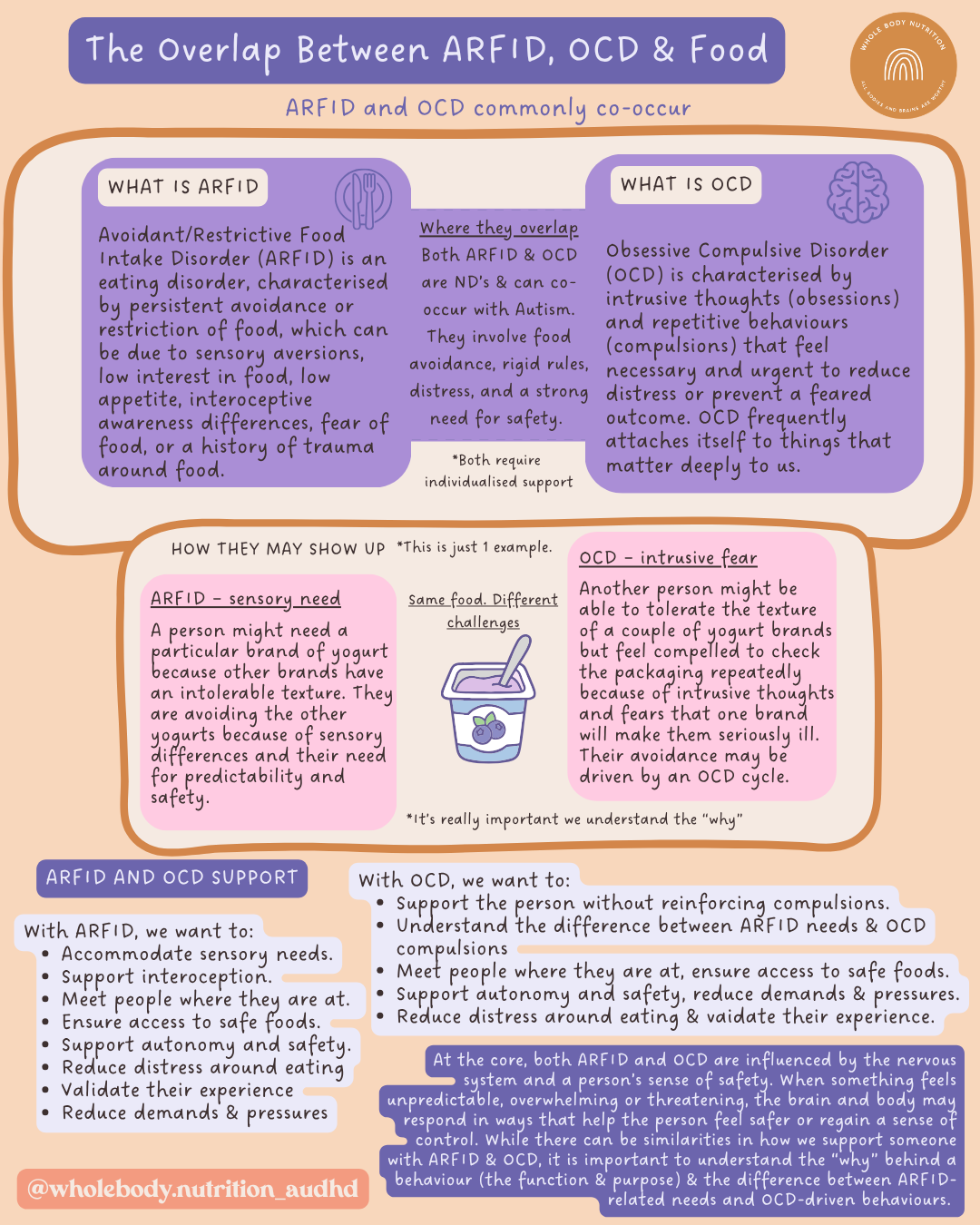
ARFID (Avoidant/Restrictive Food Intake Disorder) is an eating disorder and neurodivergence characterised by avoiding or restricting food in ways that can affect nutritional intake, growth, health or everyday life. It can involve sensory processing difference, low interest in food, low appetite, interoceptive difference, trauma around food/eating and/or fear of aversive consequences such as choking or vomiting. You can read more about ARFID here
OCD (Obsessive-Compulsive Disorder) is also a Neurodivergence that involves obsessions and compulsions. Obsessions are intrusive, unwanted thoughts, images or urges that cause distress. Compulsions are repetitive behaviours that a person feels driven to perform in response to an obsession, they are time consuming and often to reduce anxiety or prevent something bad from happening.
OCD frequently attaches itself to things that matter deeply to us. Thoughts can feel urgent, significant and frighteningly convincing. A person might feel that they must check something, ask a question, follow a rule or complete an action to prevent serious harm.
Compulsions can provide temporary relief, but that relief doesn't last. The doubt or fear often returns, creating pressure to repeat the behaviour.
When ARFID and OCD co-occur, feeding difficulties are rarely just about food. They are about self protection, fear, uncertainty, and a nervous system working overtime to try to keep the person safe.
How might OCD and ARFID show up around food?
Children with OCD may not be able to explain that they're experiencing intrusive thoughts or compulsions. Instead, parents might notice intense distress, rigid rules, repeated questions, checking behaviours or a strong feeling that something has to be done a particular way.
Some common examples include the following.
1. Fear of contamination
A child might become intensely worried that food is dirty, poisoned, gone off or contaminated. They might refuse food that has been touched by another person, even if that person has clean hands and the food is safe to eat.
They might need to inspect packaging, check expiry dates repeatedly or follow strict rules about which dates are acceptable and how long food is allowed to stay open before it has to be thrown out.
For example, a child might be unable to eat something once it’s been open for 2 days (even though it’s still perfectly okay), or won’t eat something that is close to it’s expiry date.
These fears can feel completely real and overwhelming. They aren't trying to be difficult, and telling them that the food is safe likely will not resolve the distress.
2. Fear of something bad happening around food
Some children experience intrusive fears that eating will lead to something bad happening like choking, vomiting, illness or another frightening consequence.
This can overlap with ARFID, where fear of aversive consequences, such as choking, vomiting or becoming unwell after eating, is one recognised presentation according to the diagnostic criteria. However, this does not mean that every fear around food is related to OCD.
The distinction matters. We need to understand whether a child is avoiding food due to sensory differences, low interest in food, low appetite, trauma, a previous frightening experience, an OCD cycle, or a combination of these factors.
3. Food needing to feel “just right”
For some children, food has to look, smell, feel or be prepared in an exact way before they can tolerate eating it.
Toast might need to be cut into tiny, evenly sized pieces and placed on a particular plate. Every piece might need to look the same. If one piece is slightly different, the child might feel unable to eat any of it.
Parents may see these requirements as unnecessary, however for the child, the discomfort of this uncertainty can feel unbearable.
It's also important to recognise that predictability and sameness can support sensory regulation and safety in Neurodivergent children. A preference for food to be prepared consistently and in a predictable way is not automatically a compulsion or a sign of OCD.
4. Specific brands, packaging and food rules
A child might only accept a particular brand of food, need the packaging opened in a particular order or become distressed if food touches another item on their plate.
Some children may only eat chips from a large family-sized packet. Once they've eaten as much as they want, they won't eat any more from that packet, and the remaining chips need to be thrown away. The next day, they may no longer feel safe or acceptable to eat.
From the outside, this might look confusing. But the reason behind this matters. For example; is the child responding to a change in taste, texture or freshness, making this food feel unsafe? Is the packaging part of what makes the food predictable and reliable making it safe? Is there an intrusive fear that something bad will happen if they eat the leftovers? Or are several factors interacting?
Understanding the why is so important.
5. Safe foods suddenly becoming unsafe
One of the hardest parts of supporting ARFID is that safe foods can change with fluctuating capacity.
When capacity is low a food that was manageable yesterday might suddenly feel impossible today because the spoon is different, the shape of the food has changed, the packaging looks unfamiliar or the food has been prepared at a different time.
For a child experiencing OCD, this might also involve new fears, doubts or checking rituals. They may repeatedly inspect the food to make sure it’s “acceptable to them” or ask questions to try to establish certainty before eating.
For parents, this can create a sense that the goalposts are constantly moving. And it can be difficult to keep up with new safe foods which can be frustrating for everyone. It's important to remember that these changes aren't deliberate, they are a nervous system safety response.
Why reassurance doesn't always help
When a child is distressed, our instinct is often to reassure them.
We might say:
“I promise the food is safe.”
“You ate this yesterday, and nothing happened.”
“There's no reason to be scared.”
“I've checked the expiry date. You don't need to check again.”
These responses come from a place of care. We want our children to feel safe, and we want to help them eat.
However, when OCD is involved, repeated reassurance can sometimes become part of the compulsive cycle.
The child experiences a frightening thought, seeks reassurance, feels temporarily better and then experiences doubt again. They need another answer, another check or another confirmation. Over time, the brain can learn that reassurance is necessary to feel safe, making it harder to tolerate uncertainty.
This doesn't mean parents should become cold, withdraw comfort or leave their child to manage overwhelming distress alone.
The goal is to validate the child's distress without getting pulled into an endless cycle of proving that the fear isn't true.
For example, instead of repeatedly promising that food won't make them sick, you might say:
“I can see how scary this feels. Your brain is giving you a really loud warning right now. I'm here with you. What might help you feel supported while we work through this together?”
The aim isn't to dismiss the fear, but to help the child feel safe and supported without relying on repeated reassurance.
Supporting a child with OCD and ARFID in a neurodiversity-affirming way
When eating feels threatening, flexibility is difficult to access. A child who is overwhelmed by fear, sensory discomfort or uncertainty is going to have a very small window of tolerance.
Support needs to start with safety, trust and an understanding of what is driving the difficulty.
1. Validate the experience, not necessarily the fear
You don't need to agree that the food is contaminated or that something terrible will happen to acknowledge how frightening the experience feels.
You might say:
“I can see how scary this feels for you.”
“Your brain is trying really hard to protect you.”
“That thought feels very convincing right now.”
“I can see this is really difficult for you, it’s not fair is it.”
“We can work through this together.”
Avoid describing the child as irrational, silly, manipulative or attention-seeking. These descriptions can increase shame and make it harder for them to communicate what they're experiencing.
2. Reduce pressure around eating
Pressure can increase distress and make eating feel even less safe. This includes pressure that appears positive, such as excessive praise for eating a feared food, as well as bribery, threats, consequences or insisting that a child push through their fear.
For a child with ARFID, maintaining access to accepted/safe foods is essential. These foods can provide important energy, nutrition and predictability while the child is experiencing difficulty with eating.
You can respect a child's sensory needs, routines and accepted foods without agreeing with every fear generated by the OCD. The aim is to meet a person where they are at, protect access to nourishment while working out what support will help the child over time.
3. Understand the difference between ARFID needs and OCD compulsions
To provide the best support, it’s really important we understand the difference between ARFID needs and OCD compulsions. For example, a child might need a particular brand of yoghurt because other brands have an intolerable texture. They are avoiding the other yoghurts because of sensory differences and their need for predictability.
Another child might be able to tolerate the texture of several yoghurt brands but feel compelled to check the packaging repeatedly because of intrusive thoughts and fears that one brand will make them seriously ill. Their avoidance may be driven by an OCD cycle.
Both children are seeking safety and regulation, and both deserve support. However, understanding what is driving the behaviour (the function and purpose) helps us respond in a way that meets their individual needs. With ARFID, this may mean accommodating sensory needs and ensuring access to safe foods. With OCD, it means supporting the child without unintentionally reinforcing compulsions.
A useful starting point is to ask:
Is this related to sensory comfort, predictability or difficulty tolerating the food?
Is the child experiencing an intrusive fear that something bad will happen?
Is the behaviour an attempt to neutralise that fear or obtain certainty?
Is there a physical symptom, medical concern or previous frightening experience, including trauma or PTSD, that needs to be considered?
Could more than one factor be involved?
These questions are a way for you to become curious about the child's experience rather than automatically treating all food-related behaviours in the same way.
Supporting an ARFID-related sensory need is not the same as reinforcing an OCD compulsion.
4. Understand support versus accommodation
Parents often hear that accommodating OCD can maintain the OCD cycle. This can be confusing when they're also trying to make eating accessible for a child with ARFID.
It's helpful to distinguish between adjustments that protect the child's ability to eat and repeated actions that become part of an OCD ritual.
For example, providing a reliably accepted food because of a child's sensory needs is different from repeatedly checking food to relieve an intrusive fear of contamination. Supporting genuine sensory needs helps make eating accessible, whereas repeatedly participating in compulsions can reinforce the OCD cycle.
These distinctions are not always clear-cut. What matters is understanding the “why”, what is the function and purpose of the behaviour. Also considering its impact on the child's nourishment, distress, autonomy and everyday life.
Reducing compulsions should be approached thoughtfully, ideally with an appropriately qualified OCD specialising psychologist, counsellor or social worker. It should not involve abruptly removing safe foods, forcing a child to eat feared foods, exposure to fear foods or withholding nourishment to encourage flexibility.
5. Build a team that understands both OCD and ARFID and uses a collaborative approach
When a child experiences both ARFID and OCD, it can be helpful to work with professionals who understand the differences between them. A clinician who understands OCD but has limited knowledge of ARFID may unintentionally overlook sensory differences, low appetite, nutritional risk or the importance of safe foods. Likewise, a clinician who understands ARFID but has limited OCD experience may unintentionally reinforce compulsions while trying to reduce distress.
A collaborative team approach can help ensure that the child's nutritional needs, sensory experiences, emotional wellbeing and OCD symptoms are all considered.
A final reminder for parents
If your child is experiencing OCD and ARFID, you may be carrying a lot.
You might be trying to keep them nourished, navigate ever-changing safe foods and support them through intense distress. You may feel as though you're constantly getting it wrong, but please remember that your child doesn't need a perfect parent. They need a parent who is willing to listen, learn, repair when things don't go as planned and keep showing up with compassion. You won't always know the right thing to say or do, and that's okay. What matters is building a relationship where your child feels safe, understood and supported, even when things are hard. You are learning alongside them, and you deserve compassion, too.
Remember that your child isn't trying to give you a hard time. Their behaviours may be attempts to manage fear, uncertainty, sensory discomfort or a sense of danger that feels overwhelming.
Start with understanding.
Meet them where they are at.
Protect access to safe food.
Reduce shame.
Build trust.
Seek support from professionals who understand the complexity of both ARFID and OCD.
Our goal isn't to make a child comply with eating. It's to help them feel safe enough to access nourishment and receive the support they need.
OCD and ARFID in Adults
OCD and ARFID can co-occur in adults, too. If you're an adult navigating these experiences, your struggles with food are just as valid. The fears, sensory needs and reliance on safe foods don't disappear when you grow up, and you deserve support, understanding and compassion at any age.
Autism and OCD
Autism and OCD can overlap in ways that make it difficult to distinguish between autistic needs and OCD-related behaviours. Both can involve repetitive behaviours, a strong preference for predictability, involve routines, sensory aversions, specific rules, they can be time consuming and both can experience distress when things feel uncertain or out of place. As mentioned above it is so important we understand the “why” behind a behaviour (function and purpose). For example Autistic routines and repetitive behaviours often support sensory regulation, comfort, predictability and safety, while OCD compulsions are no regulating long term, they are typically driven by intrusive thoughts, fears or a need to reduce anxiety or prevent a feared outcome. It is also important to recognise that autism and OCD can co-occur, meaning a person may experience both and need support that acknowledges each of their needs.
References
https://equip.health/articles/understanding-eds/arfid-and-ocd
https://www.melbournewellbeinggroup.com.au/melbourne-psychology-blog/ocd-and-arfid
https://pubmed.ncbi.nlm.nih.gov/41636319/
*The examples given in this blog are just examples and may not represent your experience. OCD can present in many different ways, as can ARFID. The information in this blog post has been drawn from my personal lived experience, work with my clients and research.
Some of the information in this blog is also informed by the work of Brianna Thomas and Chloe Hulse. For more learning about OCD I recommend the Psych Hive’s All About OCD E-Book and Affirming OCD Chat’s with Brianna Thomas and Chole Hulse. I also recommend reading The Joy Thief by Penny Moodie as a resource for understanding OCD.
Written by Margo White, your Melbourne-based neurodiversity affirming clinical nutritionist and Neurodivergent advocate.
This article is intended as general advice only and does not replace medical advice. It is recommended that you seek personalised advice specific to your individual needs.